Shenzhen Xingtong IOT Technology Co., Ltd.
Barcode Scanner Manufacturer with development & Invention ability

Why Histology Laboratories Need Barcode Scanners
In a histology laboratory, the biggest challenge is not scanning a barcode—it is making sure every specimen is matched to the correct patient throughout the entire workflow.
From tissue processing and embedding to microtomy and slide preparation, a single specimen may pass through multiple workstations. Most tissue cassettes look almost identical, and relying on printed text alone increases the chance of selecting the wrong sample.
The Real Challenge: Similar Samples, Different Patients
A busy laboratory may process hundreds or even thousands of tissue cassettes every day.
Although each cassette carries a unique Data Matrix code, operators often work with trays filled with nearly identical samples. When multiple cassettes share the same color, size, and layout, visual identification becomes slow and unreliable.
This is where barcode scanning becomes critical.
Instead of manually checking every label, technicians can simply scan the cassette and immediately retrieve the correct specimen information from the laboratory system.
Barcode verification reduces the risk of selecting the wrong cassette before the next processing step begins.
Why Manual Verification Is No Longer Enough
As laboratories become more automated, manual checks create bottlenecks.
Common situations include:
Confirming tissue cassettes before embedding
Matching slides with their corresponding cassettes
Verifying specimens before automated processing
Checking sample identity during quality control
Every manual verification adds time. More importantly, every manual step introduces the possibility of human error.
A Barcode Scanner Designed for Laboratory Automation
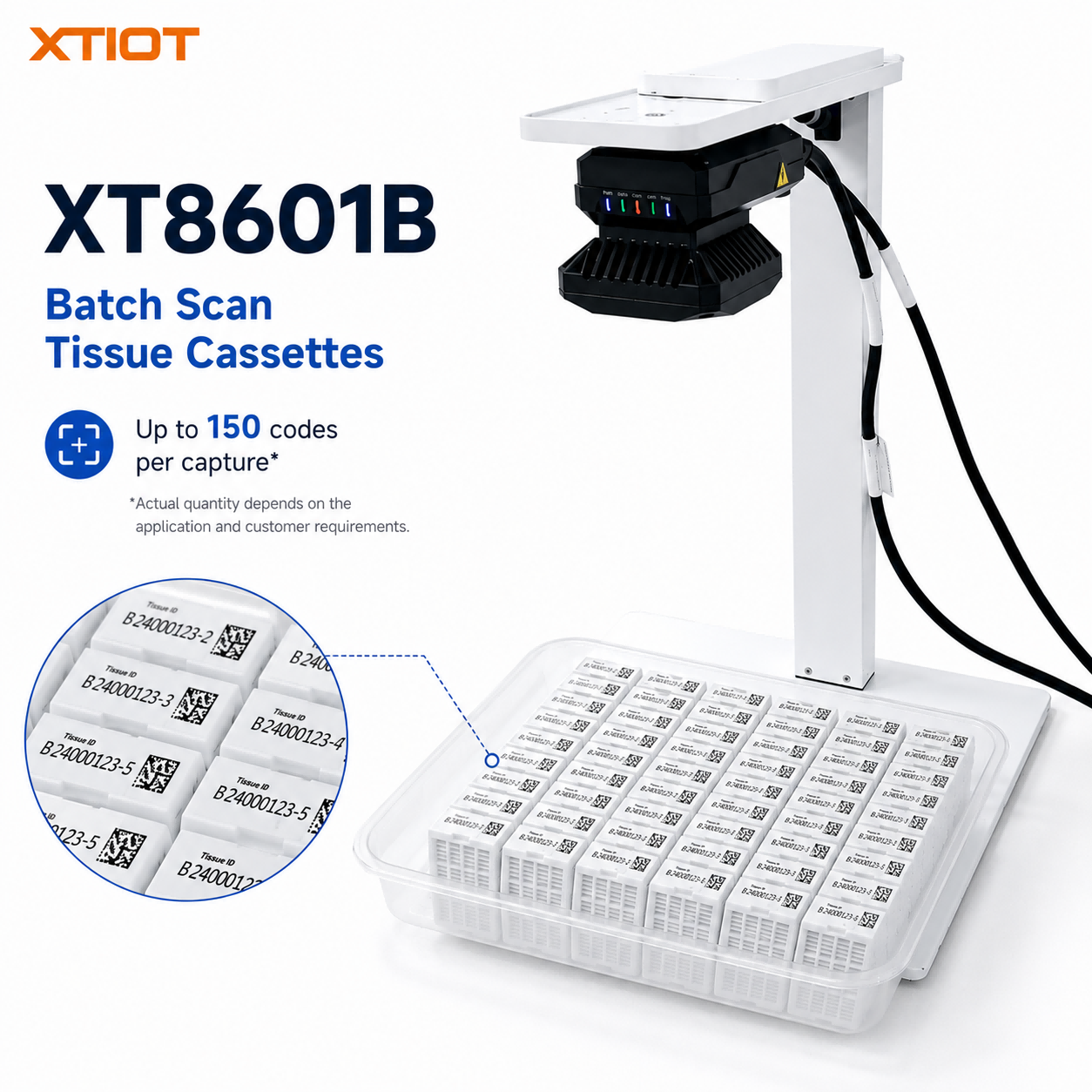
For laboratory equipment manufacturers and pathology automation system integrators, the XTIOT XT8601B provides reliable barcode reading for medical identification applications.
Key features include:
Reads small Data Matrix codes on tissue cassettes
3072 x 2048 high-resolution industrial imaging
Supports batch barcode reading for automated workflows
Compatible with LIMS, LIS, and laboratory automation systems
Easy integration through TCP/IP and RS-232 communication
Whether integrated into tissue processors, embedding centers, slide preparation systems, or laboratory automation equipment, the XT8601B helps improve identification accuracy without interrupting workflow.
Conclusion
In histology laboratories, barcode scanners are no longer just tools for reading codes—they are an important part of specimen traceability.
By replacing manual identification with fast and reliable barcode verification, laboratories can reduce errors, improve workflow efficiency, and maintain confidence that every tissue cassette remains linked to the correct patient throughout the entire pathology process.


