Shenzhen Xingtong IOT Technology Co., Ltd.
Barcode Scanner Manufacturer with development & Invention ability

Fingerprints and Grease Reduce QR Code Contrast
Unlike airport kiosks or retail terminals, restaurant self-ordering kiosks are used in an environment where customers are actively handling food and drinks.
Many customers unlock their phones immediately after eating, leaving fingerprints, oil, or moisture on the screen before presenting a QR code.
Although the QR code itself is correct, the contamination on the screen scatters light and lowers the contrast captured by the scanner. As a result, decoding may take longer, even though the display brightness is sufficient.
This problem becomes even more noticeable during lunch and dinner rush hours, when hundreds of customers use the kiosks in a short period.
Increasing Screen Brightness Doesn't Solve the Problem
Some operators ask customers to increase their phone brightness before scanning.
Higher brightness improves the display, but it cannot remove fingerprints or grease from the screen.
The scanner still needs to acquire a clean, high-contrast image. If the optical image quality is reduced by smudges, software adjustments or brighter screens provide only limited improvement.
The issue is optical, not software-related.
Replacing the Entire Kiosk Is an Expensive Upgrade
One possible solution is to redesign the kiosk by installing a larger scanner or changing the front panel.
For restaurant chains with hundreds of deployed kiosks, mechanical redesign is rarely a practical option.
Replacing metal panels, updating tooling, modifying production drawings, and reinstalling equipment significantly increase both cost and deployment time.
Most OEM manufacturers prefer to retain the existing enclosure whenever possible.
Upgrade the Embedded Scanner Instead of the Kiosk
A more practical solution is to replace the embedded scan engine with a newer imaging module.
A high-resolution scanner can capture more image detail and maintain reliable decoding even when smartphone screens are affected by fingerprints or light grease.
This improves first-pass scanning performance without requiring customers to repeatedly wipe their phones or reposition the QR code.
For restaurant operators, fewer failed scans mean faster ordering, shorter queues, and a smoother customer experience during peak hours.
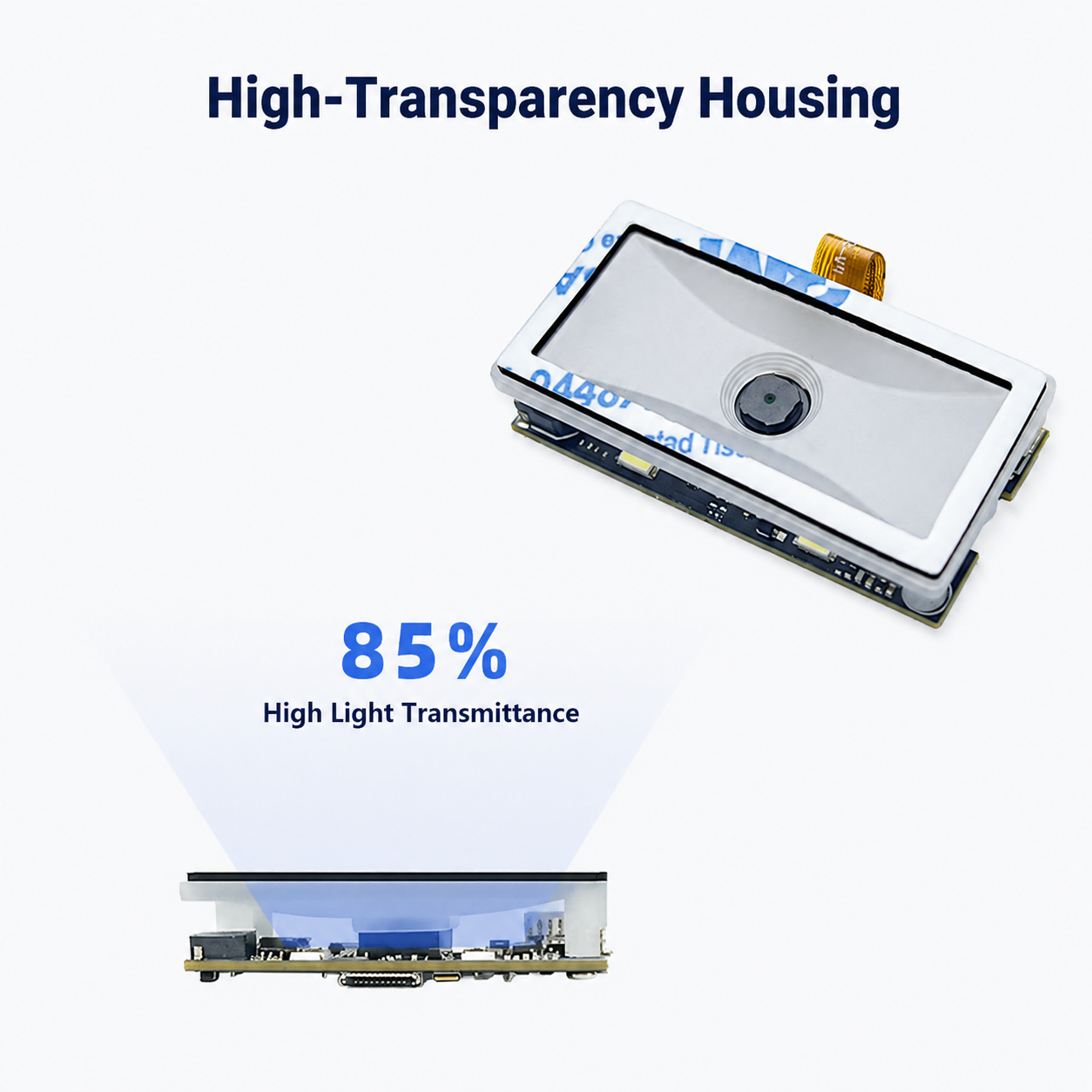
Recommended Model: XT206H1 Embedded Barcode Scanner Module
The XT206H1 is designed for OEM self-service equipment that requires reliable mobile QR code scanning in demanding environments.
Key features include:
1280 x 800 CMOS image sensor for higher image detail and improved QR code recognition
Excellent performance when reading mobile coupons, loyalty codes, and payment QR codes from smartphone screens
Automatic sensing for a faster and more intuitive ordering experience
Built-in fill light to maintain stable image acquisition under different restaurant lighting conditions
USB, TTL, and RS232 interfaces for easy OEM integration
Factory-applied double-sided adhesive around the scan window, allowing installation without additional mounting brackets
Ultra-compact design that fits existing self-ordering kiosks without changing the enclosure
The XT206H1 allows restaurant kiosk manufacturers to improve scanning performance while keeping the original mechanical design unchanged.
Conclusion
As digital ordering continues to replace traditional counter service, dirty smartphone screens have become a real-world scanning challenge that many kiosk upgrades overlook.
Rather than redesigning the kiosk enclosure, upgrading the embedded scan engine is a faster and more cost-effective approach.
With the XT206H1 embedded barcode scanner module, OEM manufacturers can improve first-pass QR code recognition, reduce customer waiting time, and modernize restaurant self-ordering kiosks without mechanical redesign.


