Shenzhen Xingtong IOT Technology Co., Ltd.
Barcode Scanner Manufacturer with development & Invention ability

Common Barcode Reading Challenges in Histology Laboratories
Many people assume barcode reading failures are caused by poor barcode quality.
In histology laboratories, this is often not the real problem.
One of the most overlooked challenges is inconsistent tissue cassette placement.
The Same Barcode, Different Results
A tissue cassette may be scanned successfully one moment and fail the next—even though the Data Matrix code has not changed.
Why?
Because the cassette itself has changed position.
In real laboratory workflows, cassettes are placed into trays manually or transferred automatically between different instruments. Small differences in angle, spacing, or height can affect the image captured by the scanner.
The barcode is still readable, but the scanner receives a less consistent view.
Why Placement Becomes a Challenge
Unlike handheld scanning, automated laboratory equipment does not reposition each cassette before scanning.
The scanner must identify every code exactly as the cassettes arrive.
Common situations include:
Cassettes are not perfectly aligned in the tray
Different cassette manufacturers have slight dimensional differences
Small gaps between cassettes change from batch to batch
Large batches require the scanner to read many codes within one field of view
These variations are normal in laboratory environments, but they increase the difficulty of maintaining a high first-pass read rate.
A Better Approach for Histology Automation
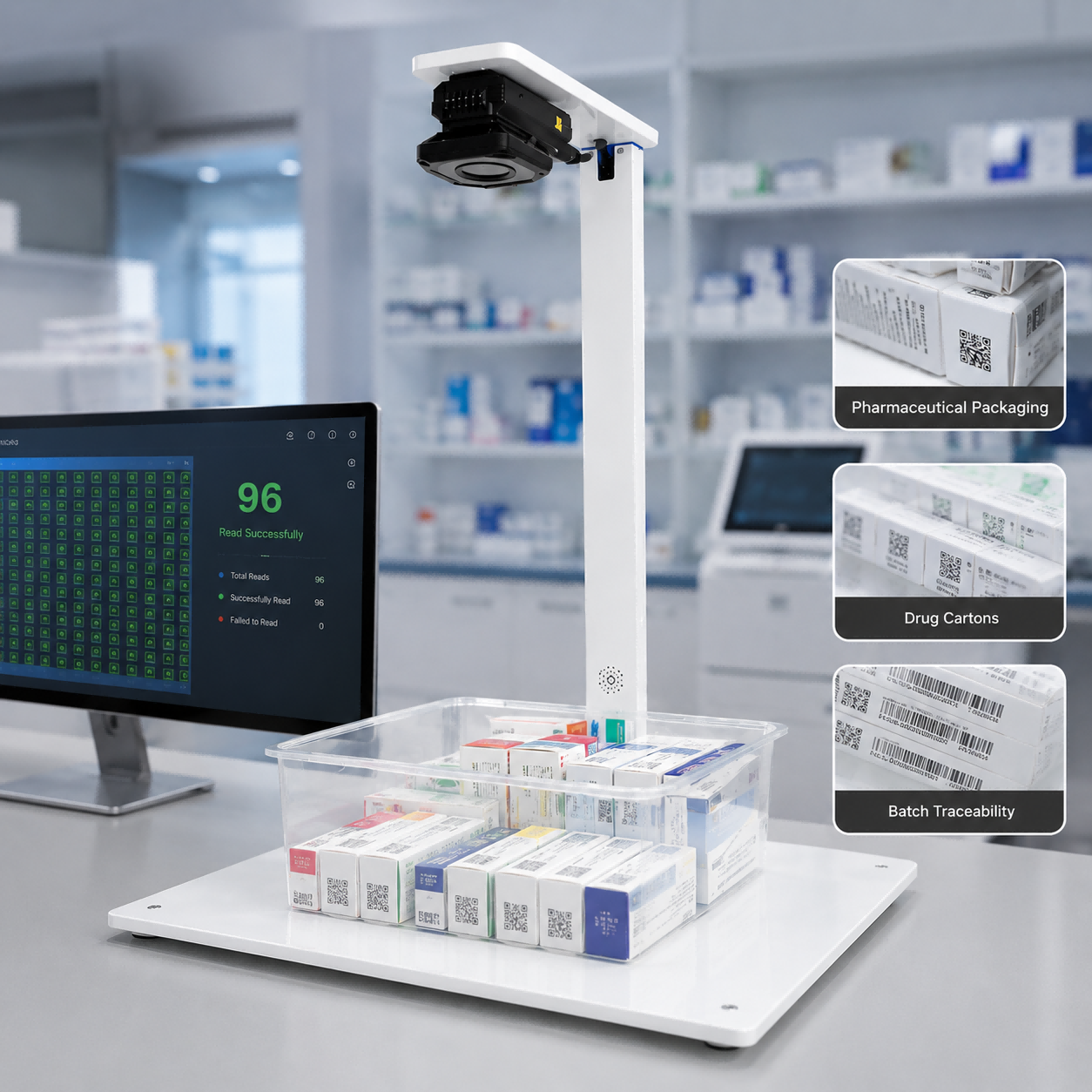
Instead of relying on perfect cassette positioning, laboratory automation systems should use high-resolution industrial imaging with a wide capture area.
The XTIOT XT8601B is designed for this type of application.
Key advantages include:
3072 x 2048 high-resolution imaging
Reliable reading of small Data Matrix codes
Supports batch scanning of multiple tissue cassettes
Suitable for automated laboratory equipment
TCP/IP and RS-232 interfaces for easy integration with LIMS, LIS, and laboratory control systems
With better image quality and industrial decoding performance, the scanner can maintain reliable reading even when cassette placement varies slightly between batches.
Conclusion
In histology laboratories, barcode quality is only one part of the equation.
Consistent barcode reading also depends on how tissue cassettes are presented to the scanner. By combining good mechanical design with a high-resolution industrial barcode scanner such as the XTIOT XT8601B, laboratory equipment manufacturers can improve first-pass read rates, reduce rescans, and build more reliable pathology automation systems.


