Shenzhen Xingtong IOT Technology Co., Ltd.
Barcode Scanner Manufacturer with development & Invention ability

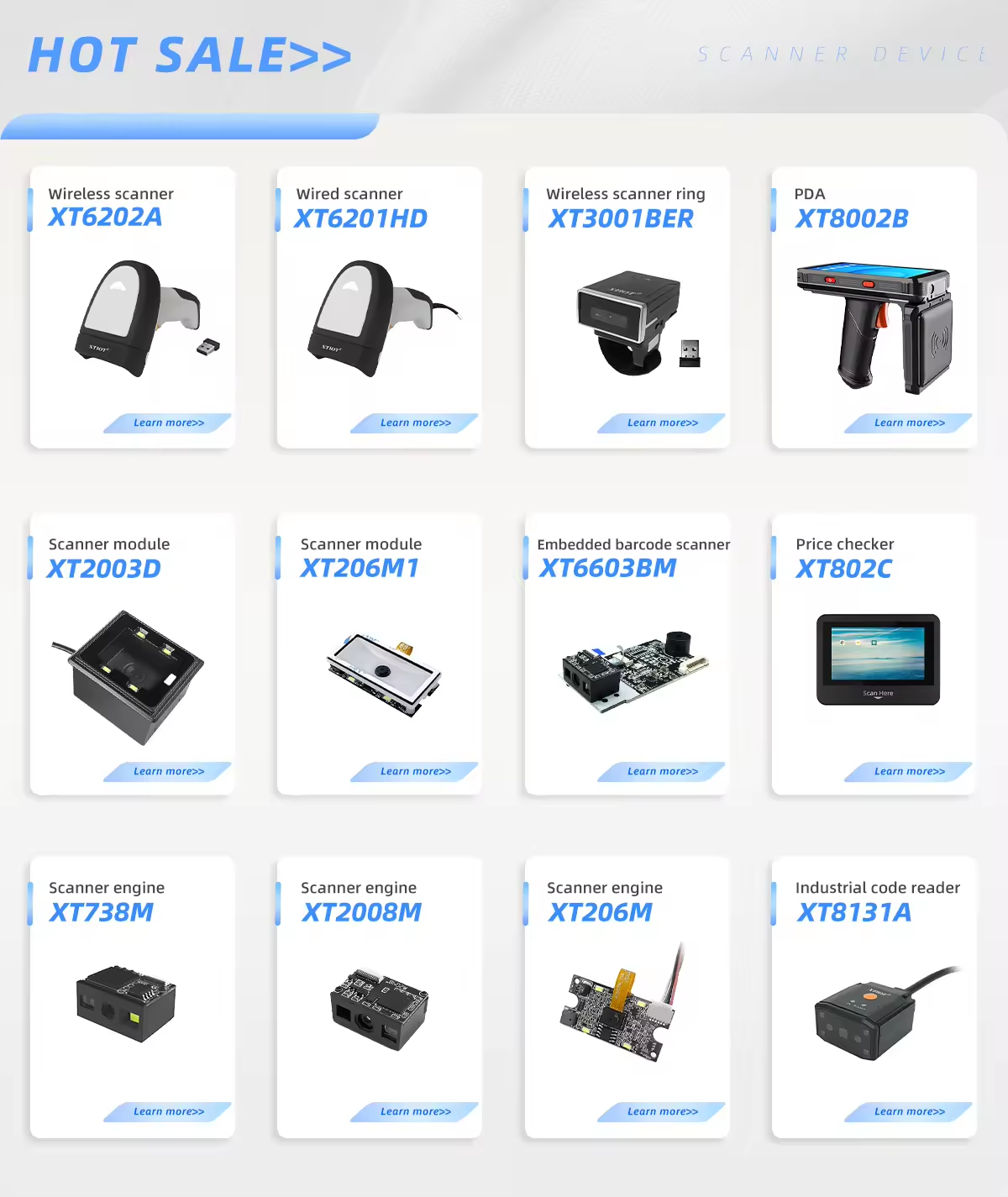
When you’re searching for a reliable barcode and QR code scanner reader module factory, the difference between vendors usually comes down to how well the hardware performs in real systems, not just raw specs on paper. That’s where factories like XTIOT start to stand out on technical grounds.
Most generic scanner modules promise 1D/2D compatibility, but the real challenges show up only once the module is embedded into a device—whether it’s a POS terminal, access control unit, industrial controller, or a smart kiosk. Modules that might look similar in a datasheet can behave very differently under real scanning conditions: reflective QR codes, low-contrast labels, curved surfaces, or handheld motion blur can all reveal limits in optics and decoding logic.
An experienced scanner module factory doesn’t treat the scan engine as an afterthought. Instead, the design process begins with understanding common pain points in barcode-based systems:
Slow decode times when faced with damaged or low-quality codes
Inconsistent readings under varied lighting or during rapid, successive scanning
Integration difficulties because of limited interface options
Frequency of field failures due to weak RF shielding or suboptimal power handling
Factories like XTIOT have focused on engineering modules that address these issues head-on. Rather than simply packing a sensor into a tiny PCB, the factory optimizes:
Optical path and sensor tuning for reliable 1D/2D scanning even with tricky codes
Efficient decoding firmware that handles batch scanning and continuous streams
Multiple interface support (UART, USB, TTL, etc.) to reduce redesign work when porting the module between platforms
Stable power design that prevents resets and deadlocks in embedded environments
This matters in practice. For example, in a retail kiosk, a poorly designed module might ‘miss’ a screen-display QR code simply because it hasn’t been tuned for varying brightness and reflection. On a production line, repeated decodes from a high-speed conveyor can show up timing issues or buffer overflows if the firmware isn’t optimized for batch decoding.
A capable factory also anticipates integration hurdles. Modules that offer flexible interface options and standard command sets free engineers from writing layer after layer of custom middleware just to get basic data output. For OEMs, that translates into shorter development cycles and fewer late-stage bugs.
In industrial use cases—like asset tracking or access control—the durability of the module matters as much as its scan performance. Scan engines built with proper shielding, thermal design, and robust connectors are far less likely to suffer from noise, interference, or environmental stress.
From a system integrator’s perspective, the benefits of choosing a thoughtful barcode/QR code scanner module factory include:
Higher first-read success rates in real scanning conditions
Reduced engineering effort for hardware and firmware integration
Lower field failure rates and easier long-term support
Faster development and deployment schedules
At the end of the day, sourcing from a factory that understands why barcode scanning fails in real systems—as opposed to just what codes it supports—makes a significant difference in how smoothly a project goes from prototype to production.


