Shenzhen Xingtong IOT Technology Co., Ltd.
Barcode Scanner Manufacturer with development & Invention ability

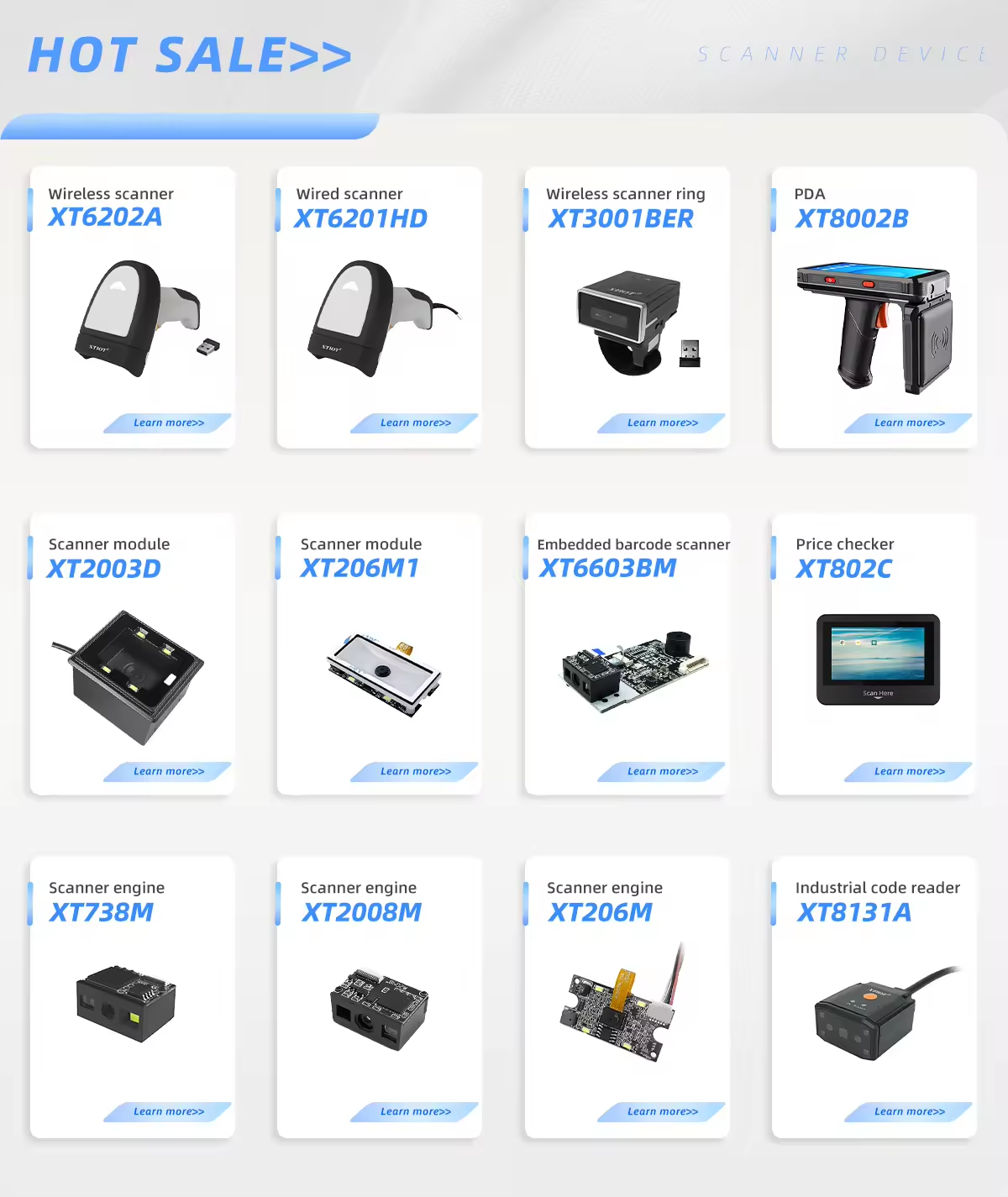
When people look at a barcode scanning vendor’s product list, it often feels like a wall of model numbers with no clear logic behind it. For system integrators, OEMs, and automation teams, that’s a real problem. Choosing the wrong scanner category at the start usually leads to redesigns, performance issues, or higher costs later.
XTIOT’s barcode scanning devices tend to be grouped by application context rather than just form factor, which is actually useful if you approach the list from a technical perspective.
At the entry level, XTIOT’s embedded scanner modules are designed for OEM integration. These are used in POS terminals, kiosks, vending machines, and access control devices. The main pain point here is space and interface flexibility. Many modules are either too large or locked into a single communication method. XTIOT modules focus on compact mechanical design while supporting common serial interfaces, which makes them easier to reuse across multiple hardware platforms. From an engineering standpoint, that reduces redesign risk and shortens development cycles.
For fixed installations, XTIOT offers desktop and fixed-mount scanners aimed at traceability, production lines, and retail counters. The typical challenge in these environments is scan stability under non-ideal conditions—damaged labels, reflective surfaces, or high-speed workflows. These scanners emphasize optical tuning and decoding stability rather than raw resolution, which matters more in continuous operation than on spec sheets.
In retail environments, price checkers and POS scanners address a different set of problems. Consumer tablets with cameras are often repurposed for price checking, but they struggle with scan speed, durability, and long-term reliability. XTIOT’s Android-based price checking devices integrate dedicated scan engines and are designed for continuous daily use, with stable connectivity to POS or backend systems. The benefit here is less staff intervention and fewer price-related disputes, driven by faster and more reliable scans.
On the mobility side, XTIOT’s rugged Android PDAs are used in warehouses, logistics, and asset tracking. The common pain points are device durability, battery life, and inconsistent scanning performance over long shifts. These PDAs focus on rugged housing, efficient power management, and industrial scan engines that can handle damaged barcodes and NFC workflows without constant retries. For operations teams, this translates into fewer device failures and cleaner data capture.
What stands out across XTIOT’s product categories is a consistent focus on deployment realities. Instead of optimizing for demo scenarios, the devices are built around long duty cycles, integration with existing systems, and predictable behavior across large-scale deployments. From a technical perspective, that consistency is often more valuable than chasing the latest hardware spec.
For teams evaluating barcode scanning equipment, a clear product classification helps avoid mismatches between use case and device capability. Looking at scanners through the lens of environment—embedded, fixed, retail, or mobile—usually leads to better long-term outcomes than comparing isolated features.
In that sense, XTIOT’s product lineup reads less like a marketing catalog and more like a map of common scanning problems and the hardware designed to solve them.


