Shenzhen Xingtong IOT Technology Co., Ltd.
Barcode Scanner Manufacturer with development & Invention ability

The Scanner Works, But the Product Cannot Enter EVT
Engineers often evaluate a new barcode scanner by looking at its decoding performance.
However, decoding performance is only one part of a successful upgrade.
If the mounting position changes by only a few millimeters, engineers may need to:
Redesign the front housing
Modify the plastic bracket
Relocate PCB components
Change cable routing
Update assembly drawings
Suddenly, a scanner replacement becomes a complete mechanical redesign.
The scanner may pass laboratory testing, but the product cannot enter the next EVT build because the enclosure is no longer compatible.
Mechanical Changes Usually Affect Multiple Departments
Many companies underestimate the impact of changing a scan engine.
A mechanical modification rarely affects only the mechanical engineer.
Once the mounting structure changes, several teams become involved.
The industrial designer must verify the front appearance.
The tooling engineer may need to modify molds.
The production engineer must update assembly instructions.
The purchasing department may need new mechanical parts.
The quality team often repeats reliability verification.
One small hardware change can create work for five different departments.
This is why many OEM projects lose several weeks after changing a scanner.
The Fastest Upgrade Is the One That Doesn't Require New Drawings
Experienced OEM manufacturers don't simply compare scanner specifications.
They ask a different question: "Can we install it without changing our product?"
If the answer is yes, development immediately becomes much easier.
No new housing.
No new tooling.
No additional structural verification.
No assembly retraining.
The engineering team can continue validating software instead of repeatedly modifying CAD files.
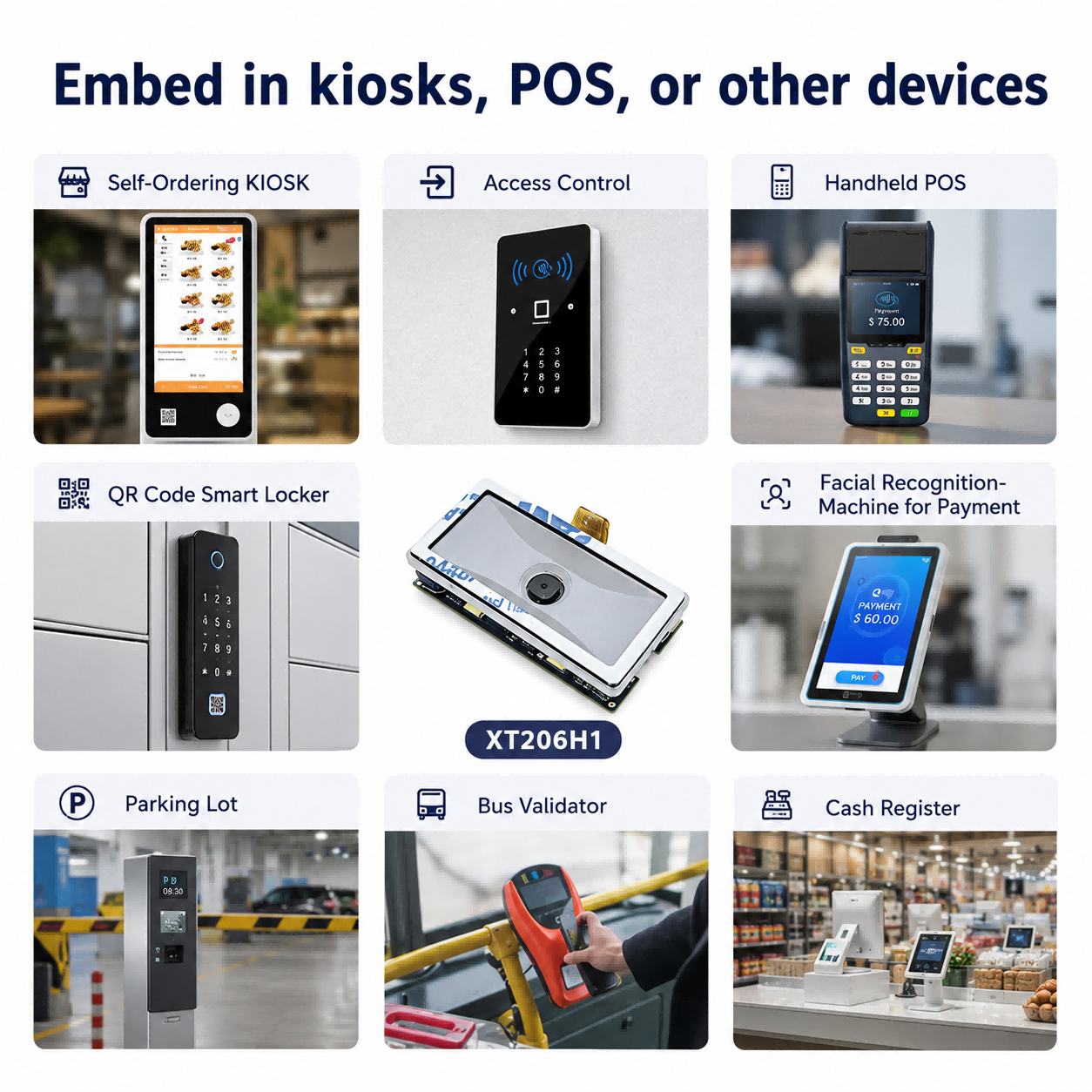
Recommended Model: XT206H1 Embedded Barcode Scanner Module
The XT206H1 was developed for OEM manufacturers that need to upgrade barcode scanning performance while minimizing engineering changes.
Its advantages include:
Ultra-compact structure for space-constrained equipment
Factory-applied double-sided adhesive around the scan window, allowing installation without additional mounting brackets in many kiosk designs
1280 x 800 CMOS image sensor for reliable mobile and printed barcode reading
USB, TTL and RS232 communication interfaces
Automatic sensing with built-in fill light
Because the XT206H1 is designed for easy integration, engineering teams can spend less time modifying mechanical structures and more time completing product validation.
Conclusion
When upgrading an embedded barcode scanner, the greatest risk is often not scanner performance—it is the additional engineering work created by mechanical redesign.
Every new bracket, every modified housing, and every updated assembly drawing extends the development schedule.
Choosing an embedded scanner that can be integrated with minimal mechanical changes helps OEM manufacturers shorten development cycles, reduce engineering costs, and bring products to market faster.


