Shenzhen Xingtong IOT Technology Co., Ltd.
Barcode Scanner Manufacturer with development & Invention ability

The Scan Window Was Originally Designed for Paper Boarding Passes
Many airport self-service terminals were installed years before mobile boarding passes became common.
At that time, the scanner was primarily used to read printed boarding passes presented a few centimeters away from the scan window.
Today's passengers use smartphones instead of paper, but their scanning behavior has changed completely.
Most passengers instinctively press the phone against the scanner glass because they believe "closer is better."
Unfortunately, when the phone is too close, the imaging system may not capture the complete QR code clearly, resulting in slower decoding or repeated scan attempts.
Software Cannot Correct an Optical Problem
Some system integrators initially try to improve the scanning experience by changing the application software.
For example, they increase the scan timeout, repeatedly trigger decoding, or modify the user interface.
None of these changes solve the root cause.
The scanner still needs to acquire a clear image before decoding can begin. If the QR code image is incomplete because of the extremely short working distance, software optimization provides only limited improvement.
Redesigning the Kiosk Front Panel Is an Expensive Solution
One possible approach is to redesign the front panel by enlarging the scan opening or relocating the scanner.
For airports, this is rarely practical.
Mechanical redesign means modifying metal or plastic parts, updating production tooling, repeating reliability testing, and potentially affecting the appearance consistency of terminals already deployed throughout the airport.
For equipment manufacturers managing large installation volumes, these costs are difficult to justify.
Improve the Scan Engine Instead of the Enclosure
A more practical approach is to replace the embedded scan engine with one that offers better tolerance for real-world passenger behavior.
The goal is not to change how passengers scan—it is to make the scanner adapt to how passengers naturally use their phones.
A modern imaging scanner can capture smartphone QR codes more quickly, even when the phone is presented at different distances or slight angles, reducing repeated scan attempts and improving passenger flow.
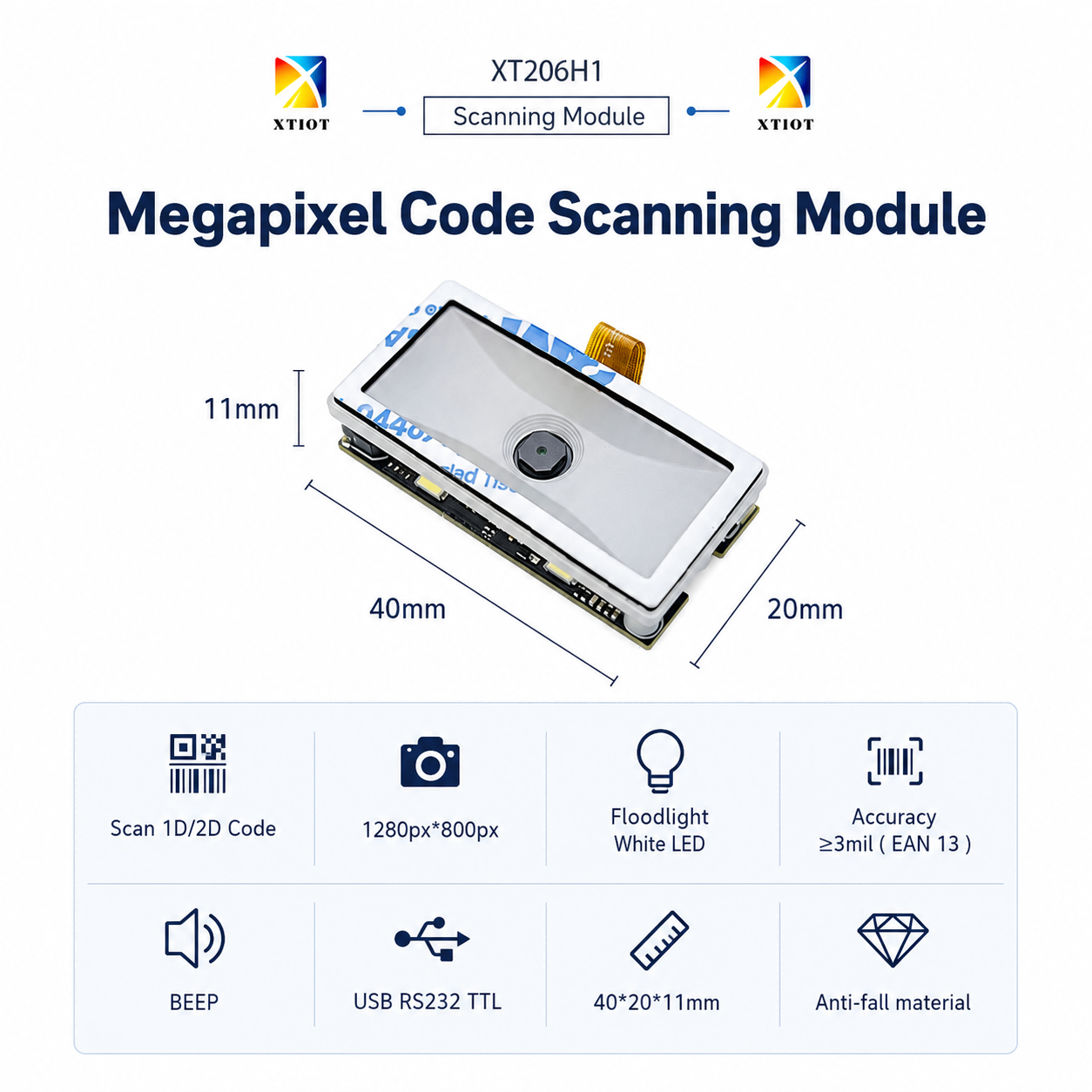
Recommended Model: XT206H1 Embedded Barcode Scanner Module
For airport self-service terminal manufacturers and retrofit projects, the XT206H1 provides a simple upgrade path without requiring mechanical modifications.
Key features include:
1280 x 800 CMOS image sensor for reliable mobile QR code recognition
Excellent performance when reading smartphone boarding passes
Automatic sensing for faster passenger interaction
Built-in fill light for consistent image capture under different terminal lighting conditions
USB, TTL, and RS232 interfaces for OEM integration
Factory-applied double-sided adhesive around the scan window, allowing quick installation without additional mounting brackets
Ultra-compact design for space-constrained airport terminals
Because the XT206H1 fits easily into existing kiosk designs, manufacturers can upgrade scanning performance while keeping the original enclosure unchanged.
Conclusion
As mobile boarding passes become the standard, passenger scanning habits have become just as important as scanner specifications.
Many passengers naturally place their phones directly against the scan window, creating an optical challenge that software alone cannot solve.
Upgrading to the XT206H1 embedded barcode scanner module enables airport equipment manufacturers to improve first-pass QR code recognition, shorten passenger processing time, and modernize existing self-service terminals without redesigning the enclosure.


