Shenzhen Xingtong IOT Technology Co., Ltd.
Barcode Scanner Manufacturer with development & Invention ability

Why Scan Position Becomes a Real Engineering Problem
Most self-service kiosks are installed with a fixed scan window.
In actual use, patients may:
Hold the phone too close to the scanner
Hold it too far away
Tilt the screen significantly
Move the phone while waiting for feedback
Present the screen before the scanner is ready
Even if the QR code itself is perfectly valid, unstable positioning can increase scan time and create unnecessary queues during busy hours.
This issue becomes more noticeable during morning registration peaks when hundreds of patients use the kiosks within a short period.
Enlarging the Scan Window Is Not Always the Answer
A common assumption is that a larger scan window will solve the problem.
In reality, increasing the opening often creates new challenges:
Larger cutouts increase manufacturing cost.
Bigger windows reduce enclosure strength.
More exposed surfaces require additional cleaning.
Existing kiosk tooling may need to be redesigned.
For OEM manufacturers, changing the front panel is often far more expensive than improving the scanning performance itself.
Improve Decoding Performance Instead of Changing the Hardware Structure
A more practical approach is to upgrade the embedded scan engine so it can decode QR codes more reliably across a wider range of user positions.
A high-performance imaging scanner can provide:
Faster QR code acquisition
Better tolerance to different scanning angles
Stable decoding from varying working distances
Reliable reading from smartphone screens with different brightness levels
As a result, patients spend less time adjusting their phones, making the check-in process smoother and reducing waiting lines.
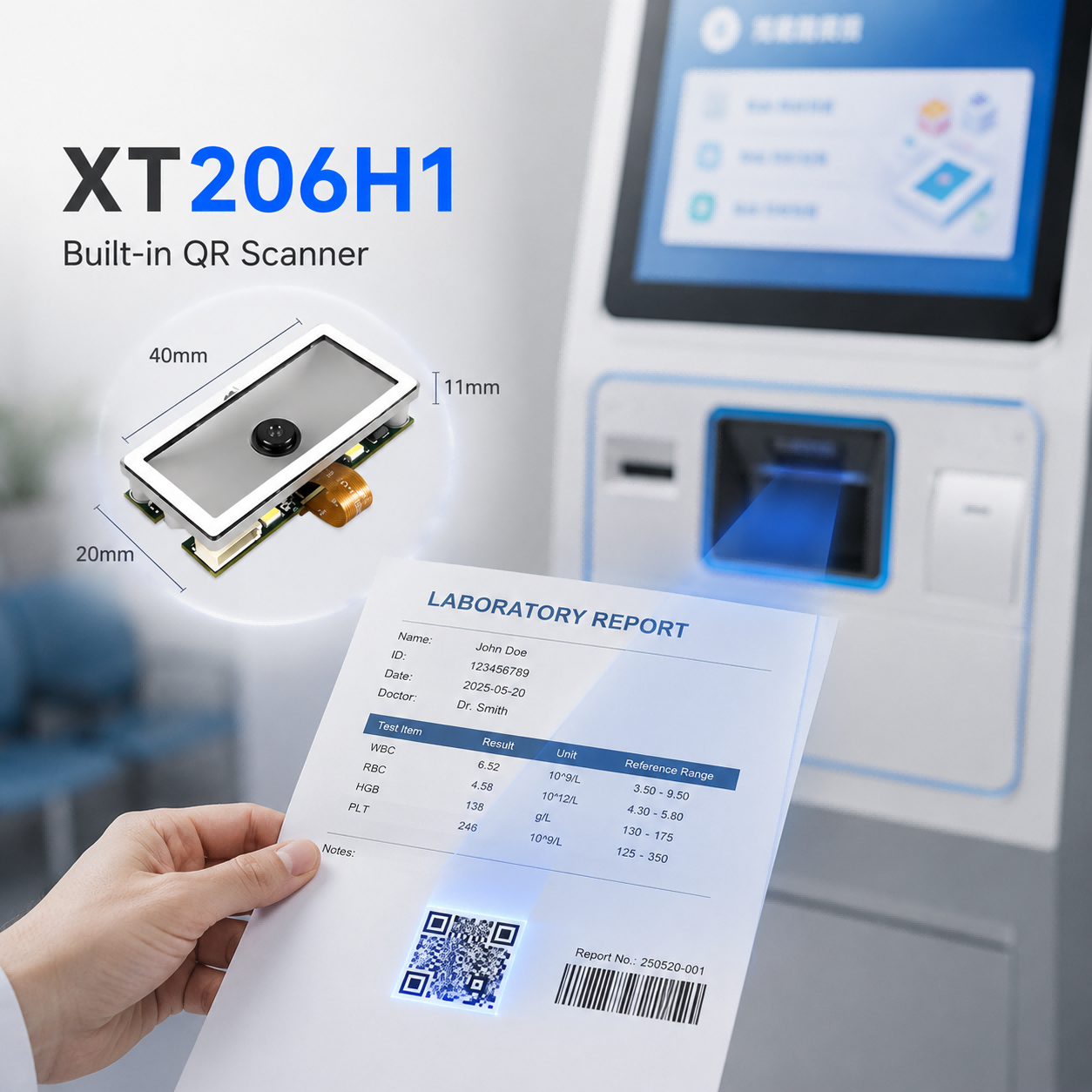
Recommended Model: XT206H1 Embedded Barcode Scanner Module
For hospital self-service kiosks, the XT206H1 is designed for OEM integration where fast and reliable mobile barcode reading is essential.
Key features include:
1280 x 800 CMOS image sensor for high-resolution screen barcode decoding
Excellent reading performance across different phone angles and working distances
Built-in fill light for dim hospital lobbies and indoor environments
Automatic sensing for faster patient interaction
USB, TTL, and RS232 communication interfaces
Factory-applied double-sided adhesive around the scan window for quick installation without complex brackets
Ultra-compact design suitable for space-constrained medical kiosks
The XT206H1 allows manufacturers to improve the patient scanning experience while keeping the existing kiosk structure unchanged.
Conclusion
As more hospitals introduce mobile QR code check-in, user behavior becomes just as important as scanner specifications.
Patients do not always hold their phones in the ideal position, so the scanner must adapt to real-world usage rather than expecting perfect alignment.
By upgrading to the XT206H1 embedded barcode scanner module, hospital kiosk manufacturers can achieve faster QR code recognition, reduce patient waiting time, and improve the overall self-service experience without redesigning the kiosk.


