Shenzhen Xingtong IOT Technology Co., Ltd.
Barcode Scanner Manufacturer with development & Invention ability

I’m an automation engineer who’s spent the last decade integrating scanning solutions into everything from automotive plants to pharma packaging lines. Let's talk about a specific, grinding inefficiency I see constantly: using handheld or fixed single-point scanners for high-volume, large-area scanning tasks.
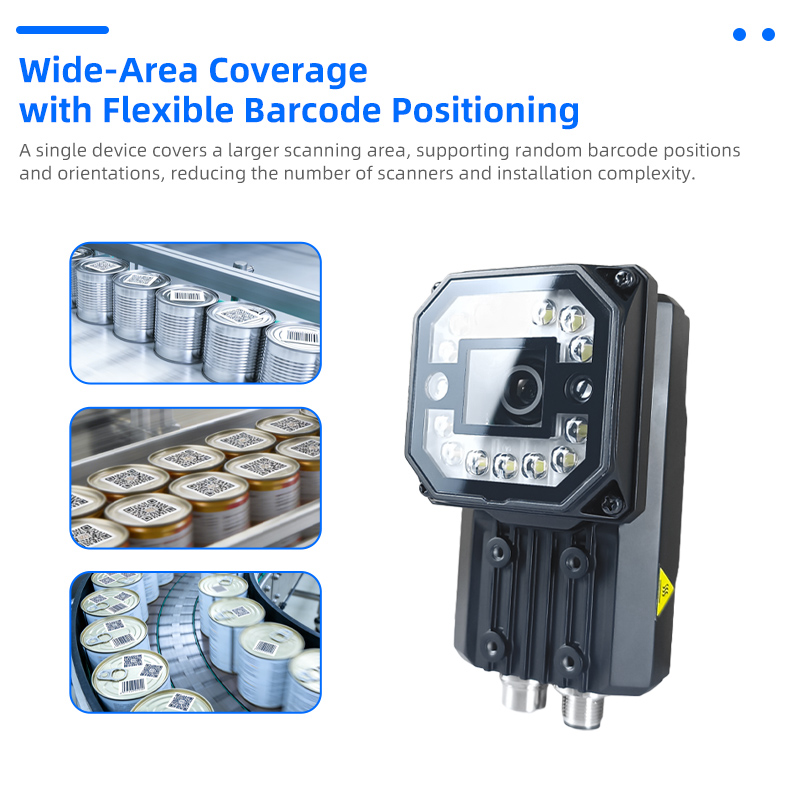
Think about a final packaging station where mixed-SKU cartons speed by, or a conveyor receiving products with multiple barcodes in random orientations. The traditional approach? Multiple fixed scanners, complex mounting, meticulous alignment, and still, you get misses. Or, a human operator with a gun, manually triggering each scan—a bottleneck and an error source.
This isn't a hypothetical. It's a daily tax on throughput and data integrity.
We recently spec'd and deployed a different type of device for a consumer electronics logistics client, the XT8501B, to solve a pallet verification nightmare. The results were revealing, not because of marketing, but because of its technical architecture. Here’s the breakdown of the problem and how the right hardware/software combo addresses it.
The Core Pain Point: The "Scanning Gap" in High-Throughput Environments
The issue isn't just reading a barcode. It's about probability. In a dynamic environment (varying distances, skewed angles, fast motion, multiple codes), a traditional laser or standard imager scanner has a limited "sweet spot." You either slow the line to guarantee capture, or you accept a miss rate that forces costly re-scans or manual intervention.
How a True Large-Area Vision Scanner Actually Works (The Tech Difference):
The XT8501B isn't a glorified handheld gun bolted to a stand. It's a purpose-built industrial vision sensor. The difference is foundational:
The "Large Scanning Area" Isn't Just a Big Lens: It's about a high-resolution global shutter CMOS sensor paired with a optimized wide-field lens. Unlike rolling shutter sensors that distort moving objects, a global shutter captures the entire scene instantaneously, freezing fast motion without blur. The lens provides a consistent, in-focus plane across a 500mm+ wide area at typical conveyor distances. This means a single device can cover the width of a standard belt, eliminating blind zones between multiple scanners.
Batch Reading is a Processing Power Problem: Seeing multiple barcodes is one thing; decoding dozens in a split second is another. This is where the onboard multi-core DSP (Digital Signal Processor) comes in. It runs proprietary decoding algorithms in parallel. Instead of scanning the image for *a* barcode, it segments the image, identifies all potential code regions, and decodes them simultaneously. We clocked it reliably reading 30+ mixed 1D/2D codes in a single 100ms frame during testing. This is the key to verifying multi-pack cartons or pallets with mixed items in one pass.
Solving the "Real-World" Variable: Depth of Field & Lighting: Products aren't flat. A case of cans has a curved surface. A tilted box changes the code's distance. The device uses a liquid lens auto-focus system that adjusts focus from near to far in milliseconds, maintaining sharpness across a 150mm+ depth of field. Combined with a programmable, multi-segment LED illuminator, it can switch lighting patterns (dark field, bright field, diffuse) on the fly to suppress glare from shrink wrap or read embossed codes on cardboard.
Integration That Doesn't Require a PhD: The biggest hidden cost is integration time. The XT8501B communicates over standard industrial protocols (EtherNet/IP, PROFINET, TCP/IP) and outputs structured data (XML, JSON strings) via its Gigabit Ethernet port. You can send it a simple JSON command via your PLC or MES to change profiles (e.g., "Switch to 'Small Parcel' mode"), and it returns a JSON packet with all codes, their coordinates, and a confidence score. This bypasses hours of custom parsing code. It also has direct I/O triggers and pass/fail outputs for simple PLC integration.
The Tangible Outcome (The "So What?"):
For our client, deploying these over pallet conveyor exits meant:
Eliminated a manual scan station: Two operators freed for other tasks.
100% Pallet Verification: Every case on the pallet is audited against the manifest automatically. Discrepancies trigger an alert before loading.
Line Speed Increased by 15%: They could run the conveyor at its optimal speed, not the scanner's limited capture speed.
Data Richness: Now their WMS receives not just "Code A was seen," but "Code A, B, and C were found at these positions on the pallet," enabling better analytics.
Final Thought:
The shift isn't from a "bad scanner" to a "good scanner." It's from a single-point data collector to an automated visual inspection system that happens to specialize in barcodes. The ROI isn't in the hardware cost; it's in closing the "scanning gap" that silently throttles your line speed, inflates labor costs, and compromises shipment accuracy. For anyone battling throughput limits or verific


