Shenzhen Xingtong IOT Technology Co., Ltd.
Barcode Scanner Manufacturer with development & Invention ability

In the 3C warehousing industry, operational efficiency directly determines a company's market competitiveness. Traditional manual barcode scanning methods, which rely on manual barcode positioning and equipment angle adjustments, suffer from inherent drawbacks such as low efficiency and high error rates, becoming a critical bottleneck hindering the digital upgrade of warehousing.
The Xingtong XT3001ER ring barcode scanner, leveraging its core technology architecture of "long-distance recognition + intelligent code compatibility," achieves active adaptation of barcode recognition to operating scenarios, technologically restructuring the warehousing barcode scanning process and providing an efficient and safe operational solution for 3C warehousing.
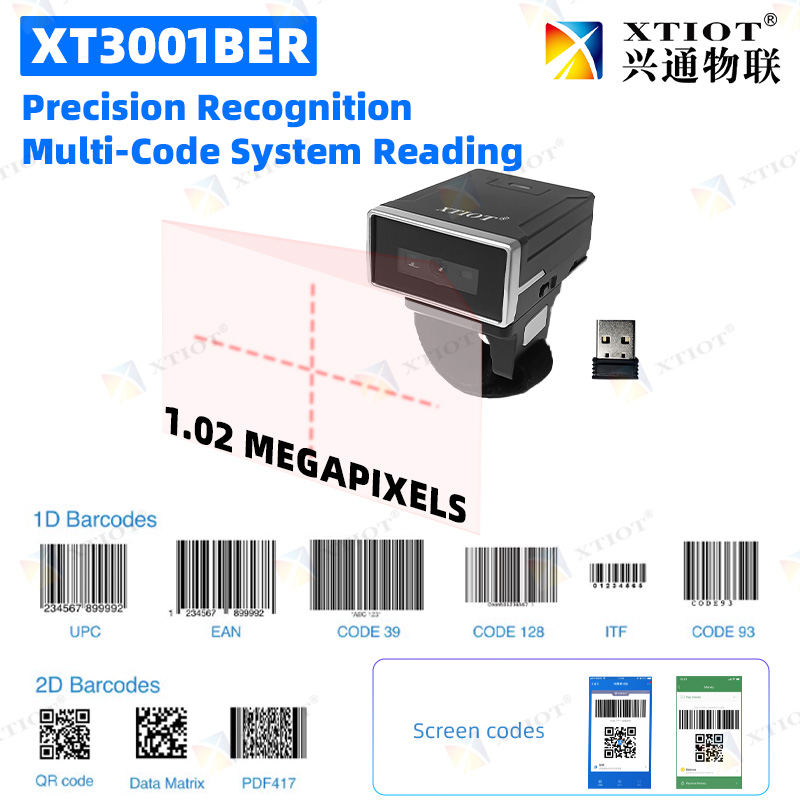
Long-distance recognition technology is the core breakthrough in addressing the pain points of high-shelf operations in 3C warehousing.
Addressing the safety hazards and efficiency problems of traditional high-shelf barcode scanning requiring climbing, the XT3001ER achieves accurate recognition at a distance of 100CM through optical system optimization and imaging algorithm upgrades. From a technical perspective, the device is equipped with a high-sensitivity image sensor and a large depth-of-field optical lens, combined with independently developed long-distance decoding algorithms, effectively improving the image clarity and decoding success rate of long-distance barcodes, allowing employees to complete high-shelf barcode scanning from the ground.
This technology not only avoids the safety risks of climbing but also saves the time cost of repeatedly using climbing equipment, shortening the single high-shelf scanning operation time by more than 60%, significantly improving shelf inventory and picking efficiency.
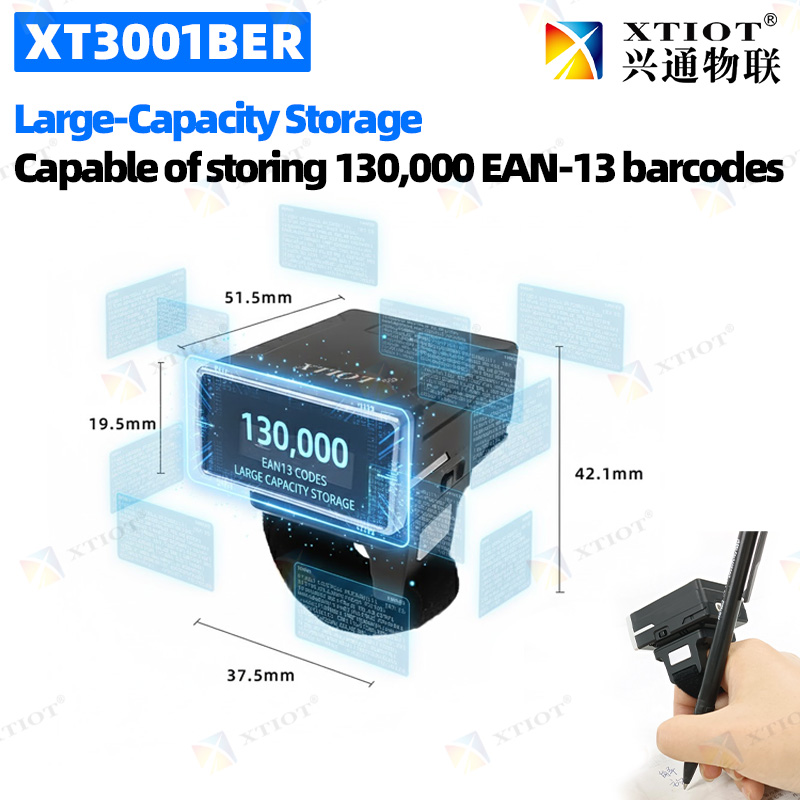
Wireless transmission and real-time data synchronization technology provide efficient technical support for mobile sorting scenarios. The XT3001ER is equipped with a 2.4G wireless transmission module and uses an anti-interference communication protocol to achieve real-time transmission of scanning data to the sorting system, technically eliminating the procedural redundancy of employees returning to their workstations to upload data in traditional modes. Actual test data shows that this technical architecture can increase daily sorting volume by 40%.
Its core advantage lies in transmission delay control at the millisecond level and its ability to handle concurrent transmission from multiple devices, adapting to the explosive order processing demands during e-commerce promotions and ensuring the efficient operation of the sorting system.
Intelligent broad-spectrum code compatibility technology solves the pain point of mixed code recognition in 3C warehousing.
3C product packaging commonly uses multiple code types such as Code128 (serial number) and QR codes (traceability). Traditional scanning devices require manual switching of recognition modes, which can easily lead to repeated scanning.
The XT3001ER utilizes a built-in multi-code decoding engine and deep learning algorithms to automatically identify and match code types, accurately decoding various mainstream 1D and 2D barcodes, achieving a single-scan success rate of over 99%. Technically, this decoding engine integrates a comprehensive code type feature library, enabling rapid barcode feature extraction and matching decoding, significantly reducing operational delays caused by mismatched code types.

Its "central control-distributed control" management technology is adapted to the large-scale multi-warehouse application needs of 3C companies.
The XT3001ER supports receiving multi-warehouse scanning data through a core control node, building a global data sharing architecture: headquarters can achieve data aggregation and inventory analysis across all warehouses through a single terminal, and each warehouse's equipment can share the data pool for dynamic resource allocation.
This technical architecture is built on the TCP/IP protocol, creating a distributed data transmission network with data encryption and access control functions. In scenarios such as seasonal inventory adjustments, it can significantly reduce cross-warehouse communication costs and improve resource scheduling efficiency.
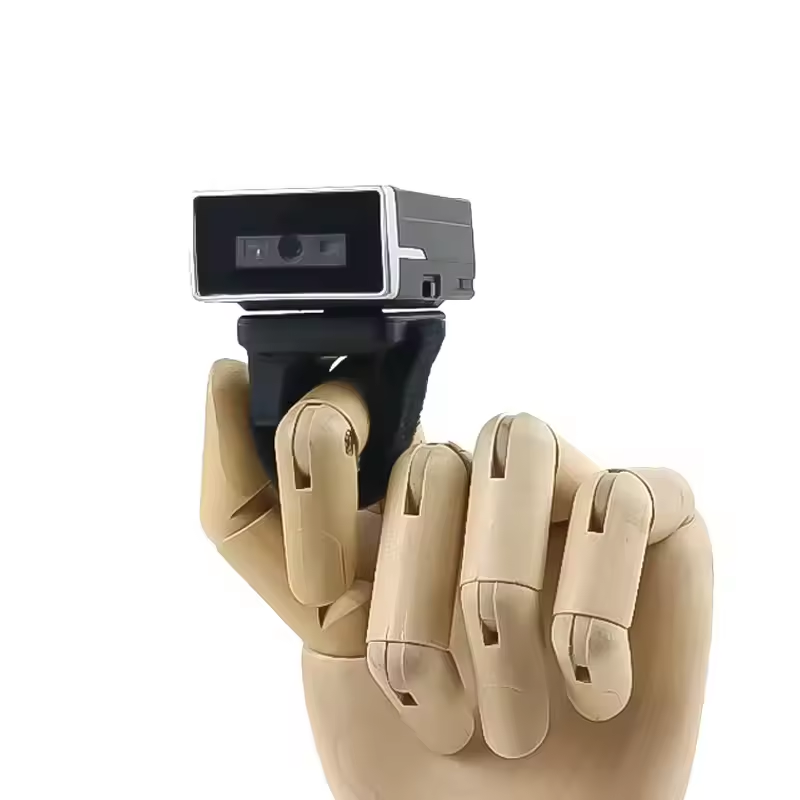
From a system integration and implementation value perspective, the XT3001ER boasts excellent compatibility, supporting multiple systems including Windows, Android, and iOS, and seamlessly integrating with mainstream WMS warehouse management systems, reducing system integration complexity. For personalized enterprise needs, customized data synchronization protocols can be developed to enhance solution adaptability. From an ROI perspective, the efficiency improvements brought about by its technology enable a single device to replace the workload of 1.5 manual barcode scanners, achieving a return on investment within 15 days, providing a cost-effective digital upgrade path for 3C warehousing companies.

In summary, the Xingtong XT3001ER ring barcode scanner accurately addresses the core operational pain points of 3C warehousing through core technological innovations such as long-distance recognition, wireless real-time transmission, and intelligent code type compatibility. Its technical architecture not only improves the efficiency of individual operational steps but also provides reliable support for the digital upgrade of the entire warehousing process through scalable management and system compatibility, making it a high-quality technical solution for improving 3C warehousing efficiency.


