Shenzhen Xingtong IOT Technology Co., Ltd.
Barcode Scanner Manufacturer with development & Invention ability

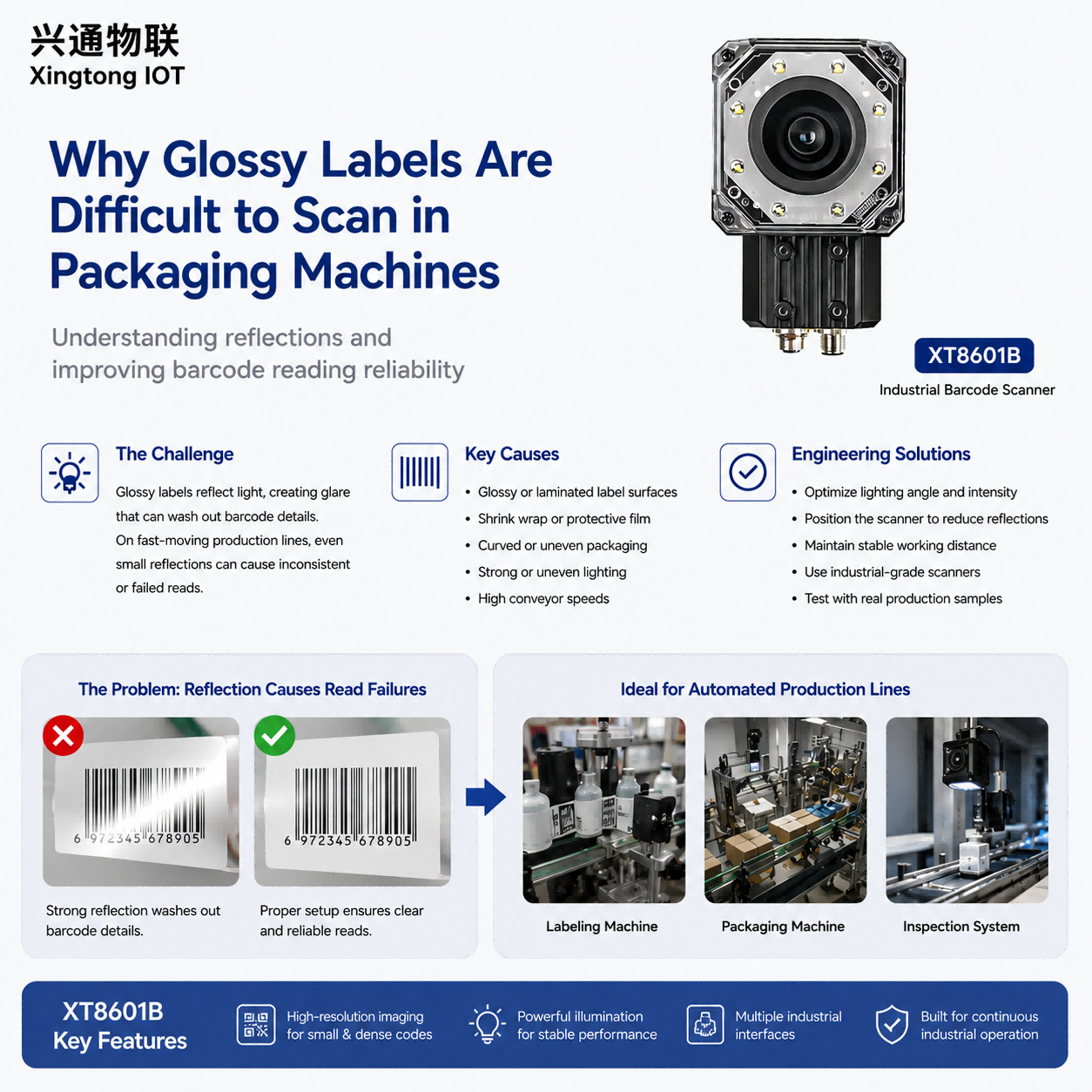
Why Glossy Labels Are Difficult to Scan in Packaging Machines
Glossy labels are widely used in industries such as cosmetics, pharmaceuticals, food, and consumer electronics because they provide excellent durability and a premium appearance.
However, manufacturers often discover that the same barcode can be read perfectly during manual inspection but occasionally fail on an automated production line.
In many cases, the barcode is not the problem—the reflective label surface is.
The Challenge: Moving Products Create Constant Reflections
Unlike handheld scanning, packaging machines read barcodes while products are moving.
As each product passes beneath the scanner, its position, angle, and surface reflection change continuously.
Glossy labels, laminated films, and shrink-wrap packaging can reflect illumination directly back into the camera.
As a result, every captured image may contain different levels of glare, even though every product uses the same barcode label.
This problem becomes more obvious when:
Products move at high conveyor speeds
Labels are covered with glossy protective film
Bottles or containers have curved surfaces
Multiple light sources illuminate the production line
The scanner must read products from different angles
A barcode that is readable when stationary may become much more difficult to decode once the production line starts moving.
Why Simply Increasing Light Doesn't Solve the Problem
Many engineers first try increasing illumination.
However, more light often produces stronger reflections instead of a clearer barcode image.
For industrial barcode reading, the quality of the captured image is far more important than the brightness of the lighting.
Successful barcode reading depends on the combination of:
Camera resolution
Lighting angle
Installation position
Exposure control
Product movement
These factors work together to determine whether the barcode can be decoded consistently at production speed.
Engineering Considerations
To improve barcode reading performance on glossy packaging, equipment manufacturers typically focus on both optical design and mechanical integration.
Common engineering practices include:
Installing the scanner at an angle to reduce direct reflections
Using stable industrial illumination
Maintaining a fixed distance between the scanner and the product
Reducing vibration on the conveyor
Testing with actual production packaging instead of paper samples
Optimizing the installation often provides greater improvements than simply increasing scanner brightness.
Recommended Barcode Scanner
For packaging machines, labeling equipment, and automated inspection systems, the XTIOT XT8601B is designed for demanding industrial barcode reading applications.
Key features include:
High-resolution industrial imaging for small and high-density barcodes
Reliable reading of Data Matrix, QR Codes, and 1D barcodes
Designed for continuous operation on automated production lines
Supports multiple industrial communication interfaces
Suitable for packaging machines, labeling equipment, pharmaceutical production, cosmetic manufacturing, and industrial traceability systems
When integrated with proper lighting and mechanical positioning, the XT8601B helps manufacturers achieve more stable barcode reading on glossy and reflective product labels.


