Shenzhen Xingtong IOT Technology Co., Ltd.
Barcode Scanner Manufacturer with development & Invention ability

Why the Barcode Scanner Matters More Than You Think
If you're developing automated dispensing cabinets (ADC), pharmacy robots, prescription dispensing kiosks, or medicine vending machines, the barcode scanner is one of the most important components inside your equipment.
End users don't judge the barcode scanner—they judge your machine.
A scanner that fails to read a medicine label quickly can interrupt dispensing, slow down pharmacy operations, and reduce confidence in the entire system.
For OEM manufacturers, selecting the right scan engine is not simply about reading barcodes. It's about building equipment that is fast, reliable, and easy to integrate.
Pharmacy Equipment Creates Unique Scanning Challenges
Unlike retail POS systems, pharmacy automation equipment must handle a wide variety of medicine packaging.
Typical challenges include:
Small GS1 DataMatrix codes on medicine boxes
Tiny QR codes on pharmaceutical labels
Curved bottles and ampoules
Reflective blister packaging
Plastic medicine containers
Electronic prescription QR codes displayed on mobile phones
These applications require high decoding accuracy and consistent performance, even when barcodes are small or difficult to capture.
Four Questions Every OEM Manufacturer Should Ask
1. Can the Scanner Read Small Pharmaceutical Barcodes Reliably?
Many pharmaceutical manufacturers now use GS1 DataMatrix for product identification and serialization.
These symbols are often much smaller than standard retail barcodes.
A high-resolution scan engine helps ensure reliable decoding without forcing users to reposition medicine packages repeatedly.
2. Will It Fit Inside My Equipment?
Space is always limited inside pharmacy automation equipment.
Many OEM manufacturers have already completed their mechanical design before selecting the scanner.
A compact scan engine reduces redesign costs and simplifies installation.
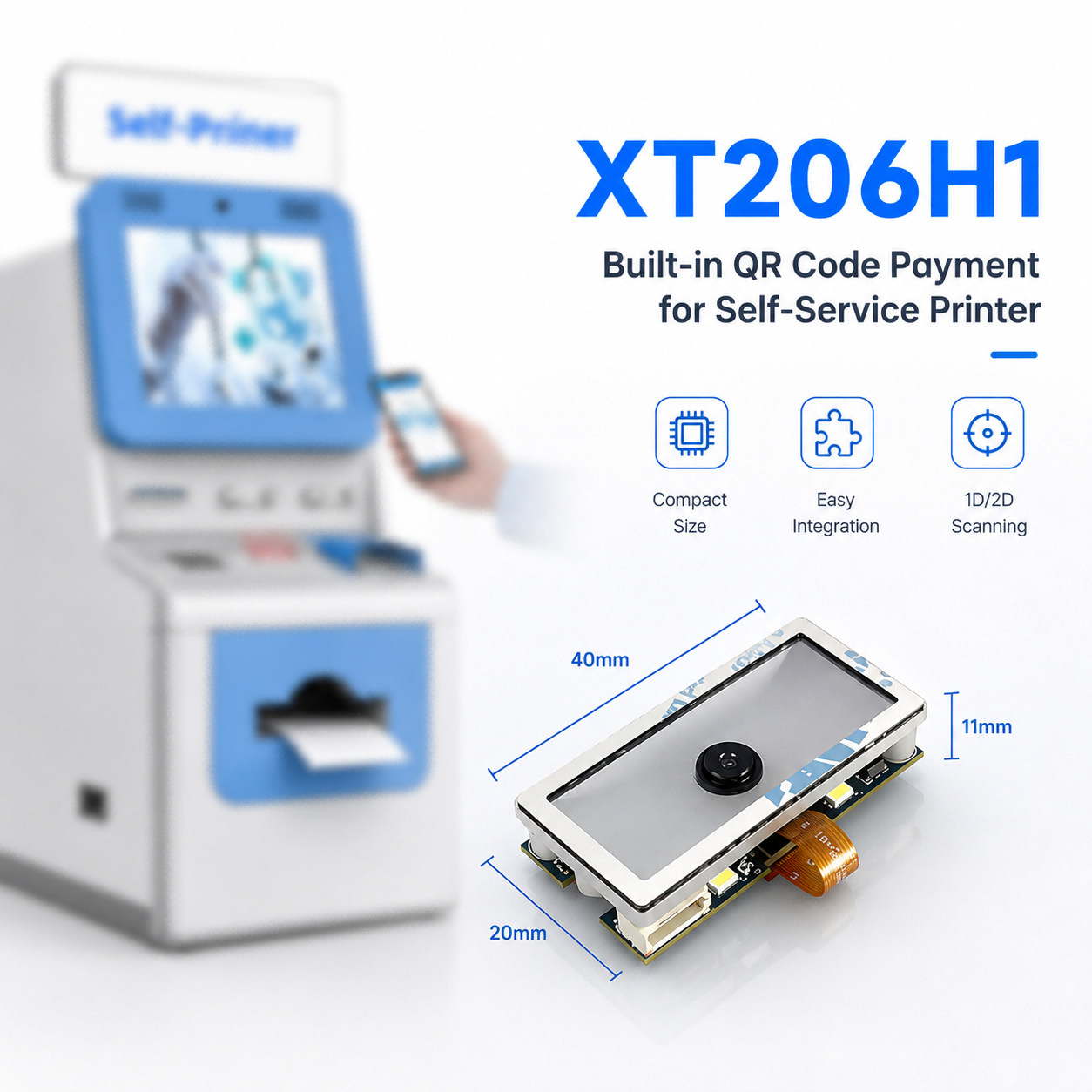
XT206H1 measures only 40 × 20 × 11 mm, making it suitable for compact pharmacy devices without sacrificing scanning performance.
3. Does It Support Multiple Communication Interfaces?
Different pharmacy equipment uses different controllers.
A scanner should integrate easily with:
USB
TTL
RS232
Flexible interfaces allow manufacturers to connect the scanner directly to industrial controllers, embedded computers, or custom control boards.
4. Can It Read Both Printed and Digital Codes?
Modern pharmacies increasingly rely on digital workflows.
Operators may need to scan:
Medicine packaging
Electronic prescriptions
Mobile pickup QR codes
Patient registration codes
Choosing a scanner that handles both printed labels and screen barcodes helps future-proof your equipment.
Recommended Barcode Scanner for Pharmacy OEM Equipment
XT206H1 High-Resolution Embedded Barcode Scanner
For most pharmacy automation projects, XT206H1 offers an excellent balance of performance, size, and integration flexibility.
Why OEM Manufacturers Choose XT206H1
1280 × 800 high-resolution image sensor
Reliable reading of small GS1 DataMatrix and QR Codes
Compact 40 × 20 × 11 mm design
USB, TTL, and RS232 interfaces
Fast paper and screen barcode decoding
Easy integration into custom pharmacy equipment
OEM & ODM customization available
Instead of designing your equipment around the scanner, XT206H1 is designed to fit into your equipment.
Planning for Future Pharmacy Systems
Pharmacy automation continues to evolve.
More healthcare providers are adopting:
Medicine serialization
GS1 standards
Electronic prescriptions
Automated dispensing
Digital patient identification
Smart pharmacy cabinets
Selecting a barcode scanner with high-resolution imaging, compact dimensions, and multiple interface options allows your equipment to support both current and future pharmacy applications.
Conclusion
For pharmacy automation equipment manufacturers, choosing an embedded barcode scanner is a hardware design decision—not simply a purchasing decision.
The scanner should be compact, easy to integrate, and capable of reading small pharmaceutical barcodes as well as digital QR codes with consistent accuracy.
XT206H1 is designed specifically for OEM integration, combining high-resolution decoding, compact dimensions, and USB / TTL / RS232 connectivity in a single embedded scan engine.
Whether you're developing automated dispensing cabinets, pharmacy kiosks, medicine cabinets, or prescription automation systems, selecting the right scan engine helps improve equipment reliability and provides a better user experience for your customers.


