Shenzhen Xingtong IOT Technology Co., Ltd.
Barcode Scanner Manufacturer with development & Invention ability

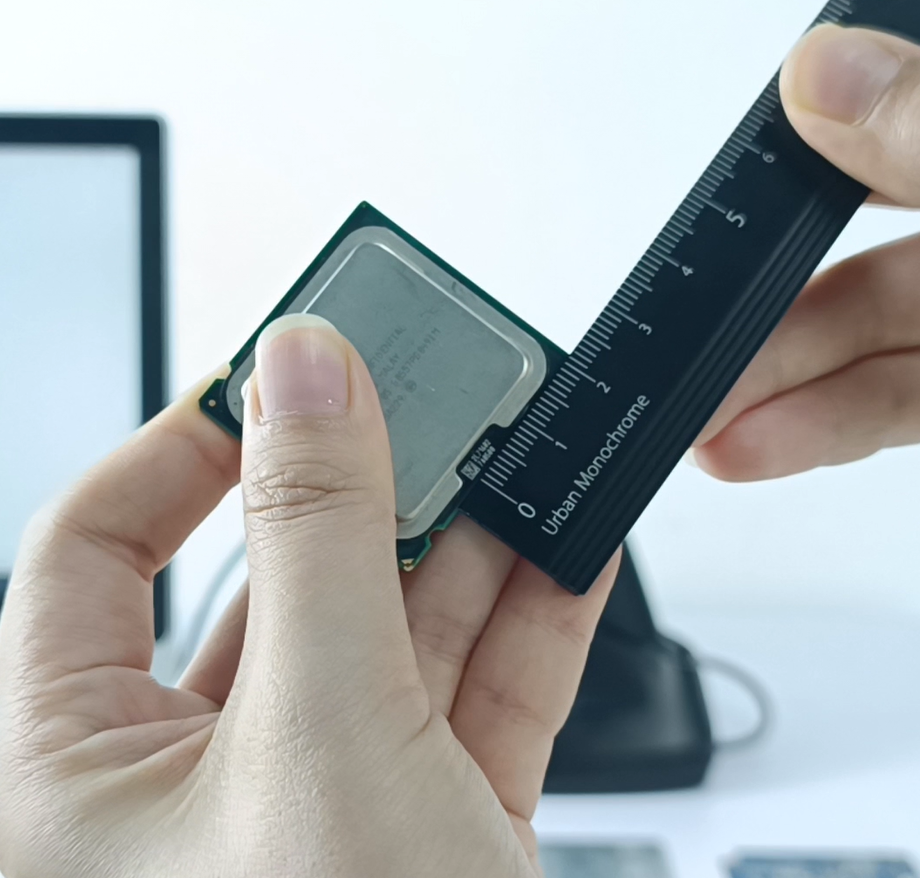
Many OEM manufacturers successfully read QR Codes during laboratory testing.
However, after the equipment is installed on the production line, small QR Codes suddenly become difficult to decode, even though the labels are printed using the same printer and meet the same quality standards.
Why does this happen?
The Challenge: Production Labels Are Smaller Than Test Labels
During equipment development, engineers often validate barcode performance using sample labels that are easy to read.
The actual production label, however, may be much smaller.
For example:
Prototype label: 20 x 20 mm
Production label: 5 x 5 mm
Both labels contain valid QR Codes.
But they require completely different imaging conditions.
A scanner that performs perfectly during development may struggle once the final product enters mass production.
The Hidden Problem: The Scanner Isn't Seeing Enough Detail
Many engineers immediately suspect poor printing quality.
In reality, the scanner may simply not capture enough image detail.
If the working distance is too long, or the field of view is designed to capture an entire product instead of the barcode itself, the QR Code occupies only a small portion of the image.
The barcode is still visible.
It just doesn't contain enough useful pixels for reliable decoding.
This issue is especially common in:
PCB manufacturing
Medical device traceability
Lithium battery production
Precision electronic components
Laboratory automation
Why Better Printing Doesn't Always Solve the Problem
When read failures occur, manufacturers often ask the label supplier to improve print quality.
While printing is important, better printing cannot recover image information that was never captured by the scanner.
If the barcode is too small relative to the scanner's field of view, increasing print contrast alone will not significantly improve read rates.
In many projects, optimizing the optical setup delivers a greater improvement than changing the barcode itself.
Engineering Considerations
Before replacing the barcode or changing the label design, OEM manufacturers should verify the scanning system itself.
Recommended practices include:
Match the scanner's field of view to the actual barcode size
Maintain a stable working distance during production
Minimize vibration while capturing images
Validate performance using the final production label instead of oversized test samples
Select an imaging system suitable for small, high-density codes
These adjustments often improve first-pass read rates without changing the barcode design.
Recommended Barcode Scanner
For applications requiring reliable reading of small QR Codes, high-density Data Matrix symbols, and industrial traceability codes, the XTIOT XT8601B is designed for demanding production environments.
Key features include:
High-resolution industrial imaging for small and dense barcodes
Reliable decoding of QR Codes, Data Matrix, and 1D barcodes
High-speed image capture for continuous production lines
Industrial communication interfaces for factory automation
Suitable for PCB manufacturing, medical devices, laboratory automation, lithium battery production, and precision industrial inspection
With proper optical configuration and mechanical installation, the XT8601B helps manufacturers achieve more reliable first-pass reading of high-density QR Codes in real production environments.


